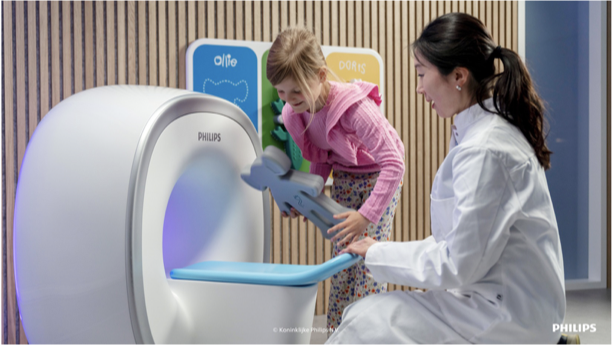
Design for Healthcare, Trust, and Human Wellbeing
At Philips, the work is deeply personal — designing for healthcare means designing for moments where trust is everything. From patient monitors to clinical workflows, every design decision carries real stakes for real people.
Leading a global team of 400+ designers across software, hardware, usability, and service ecosystems — all focused on radical empathy, trust, and improving outcomes for patients and clinicians in over 100 countries.
The 8:30 PM Prototype
In 2022, we were testing a hospital patient monitor prototype. It was late — 8:30 p.m. We were watching a video feed with three designers and a real clinician interacting with a rough demo created with an iPad stuffed in a 3D printed box. Our CEO, Roy Jakobs, joined from an airport lounge with his camera off, just listening. Afterward, he was energized — not by polished slides, but by messy reality.
"The most powerful leaders are not the most intimidating. They are the most present and willing to truly understand what is going on."
AI in Healthcare Design
The intersection of AI and healthcare design is where the most important work is happening. AI is not replacing human judgment — it's augmenting it. At Philips, we're building AI-powered clinical decision support, intelligent monitoring systems, and predictive analytics that help clinicians spend more time with patients and less time with screens.
We can identify that someone will become unstable hours before it happens, enabling early intervention. But AI can be a great distraction or a powerful accelerator — it depends on where you apply it. Prototypes that used to take months are now made in minutes, but that doesn't resolve the central problem: technology does not substitute empathy.
"If I gave an hour back to these professionals, they'd all give the same answer: spend more time with the patient."
We need to make clear what was generated by AI and what is human. The more invisible the technology becomes, the more important it is to make its limits explicit. Trust is fundamental.
Empathy as a Superpower
At the 2025 Global Innovation Forum in London, I spoke about empathy as a superpower in design leadership. In healthcare, empathy isn't a nice-to-have — it's critical infrastructure. Every interface, every alarm, every workflow represents a moment where a clinician is making life-or-death decisions. Our job is to remove friction, reduce cognitive load, and create space for human connection.
The design team at Philips operates on three principles: radical empathy for patients and clinicians, systemic thinking across entire care pathways, and rapid prototyping to test ideas in real clinical settings.
Design Transformation at Scale
Since 2020, the Philips design organization has undergone a transformation — shifting from a product-focused design studio to a systems-thinking design engine. We work across the full continuum of care: from consumer health (oral care, personal care, sleep) to professional healthcare (patient monitoring, diagnostic imaging, image-guided therapy, and clinical informatics).
This means designing not just devices, but entire ecosystems — the software that connects them, the workflows that surround them, and the experiences of patients who depend on them.
Recent Keynotes & Thought Leadership
As Global Head of Design at Philips, I deliver 3-4 global keynotes per year on design leadership, AI in healthcare, and building trust at scale:
-
WebSummit 2025, Lisbon
Keynote on how AI is transforming healthcare design — exploring the intersection of artificial intelligence, empathy, and clinical outcomes.
-
South Summit Brazil 2026, Porto Alegre
Keynote on design for human wellbeing and trust in the age of generative AI at Latin America's largest innovation summit.
-
Global Innovation Forum 2025, London
Empathy as a Superpower — design leadership and the role of human-centered innovation in global healthcare.
-
FUTURES Conference 2024
Design for Human Wellbeing in the Context of Generative AI — exploring the CHALLENGING Perspective on design's role in an AI-first world.
-
EXAME Interview, South Summit Brazil 2026
"Why the giant Philips believes the AI era demands more — not less — humanity." In-depth feature on humanity-centered design, AI in healthcare, and why the more powerful the technology, the greater the effort needed to re-center care on people.
Featured: WebSummit 2025 Keynote
Design Agenda
"Design in healthcare is about one thing: earning trust. Every pixel, every interaction, every workflow is a promise to a patient that someone cares enough to get it right."